Your neighbourhood park might be shaping your next big idea
In October 1999, Antje Danielson and Robin Chase struck up a conversation while watching their children play at a park. Danielson had observed a transportation problem in her neighborhood, shared the idea with Chase, and the two went on to found Zipcar. This is what we call “Anecdata” – an interesting data point but is there more to it on larger scale? In this case, was it a lucky coincidence, or does it reflect something more systematic about how breakthrough ideas get generated?
Our ongoing research, “Parks and Invention,” suggests it may be the latter. Using detailed data on tens of thousands of inventors across major English cities, which we linked to European Patent Office records spanning 1977 to 2018, we found that inventors who lived closer to neighborhood parks produced significantly more disruptive inventions. Not more inventions overall, but more disruptive ones.
Where you live – not just where you work – is increasingly likely to shape the nature of your creative output.
That distinction matters. In our study, we measure how unique an invention is, versus if it is simply an iteration of an existing idea. We do this by looking at patent citations: if a patent references a previous invention without also referencing the older work it built on, that is a sign the invention broke new ground rather than incrementally improved upon what already existed. By this measure, inventors who live within 500 meters of a park are 21% more likely to produce unique inventions than those living more than 7 kilometers away. And, this relationship is not simply a matter of who chooses to live near parks. Our results still hold when we account for the residential sorting of more innovative inventors close to parks.
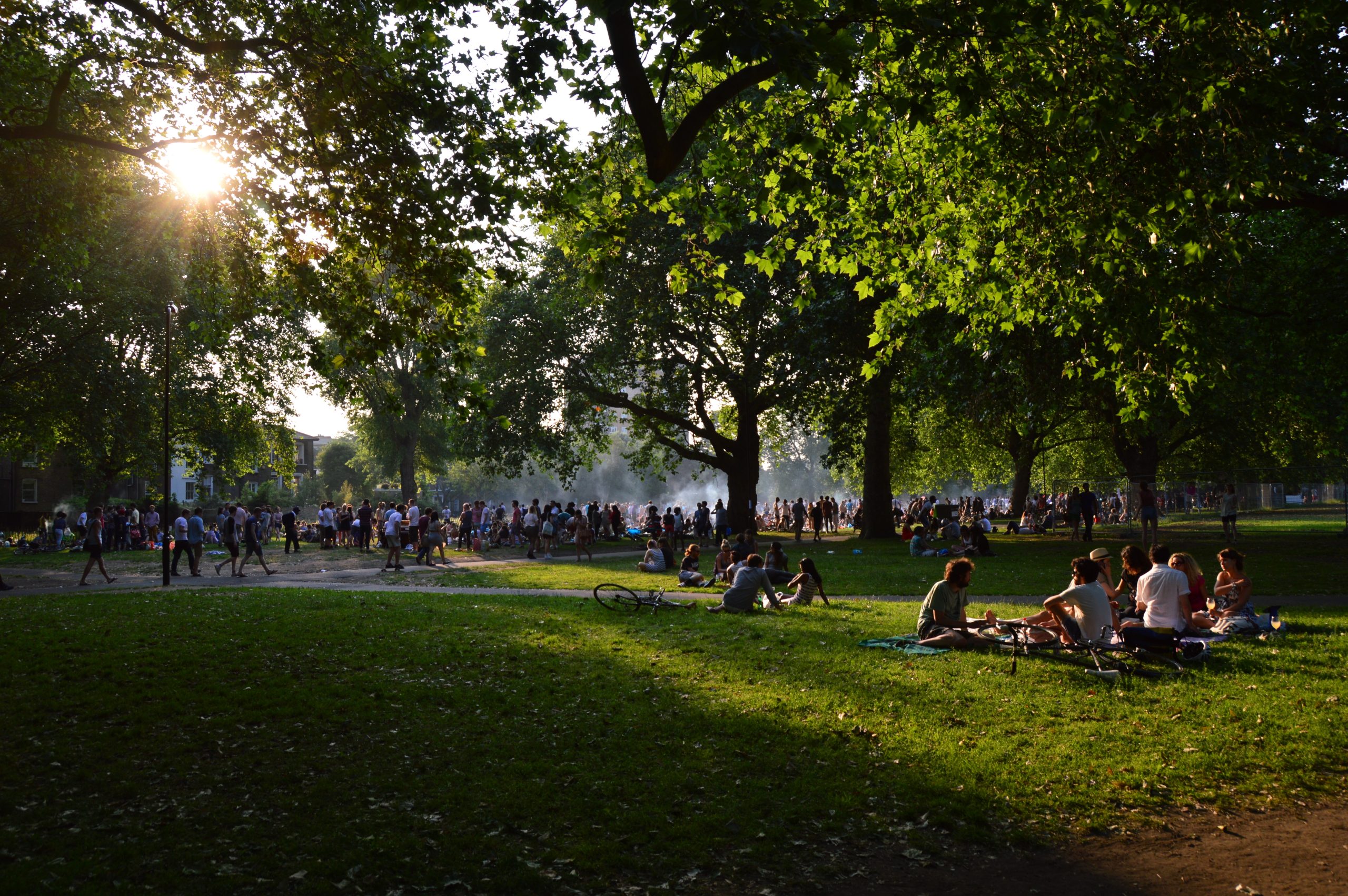
So why parks? Parks are what urban theorist Jan Gehl calls places of “optional interaction” – unplanned, voluntary encounters that happen outside any formal or professional context. Unlike offices, coworking spaces, or even coffee shops, parks impose no entry requirements and attract genuinely diverse cross-sections of the community. These include dog walkers, parents, elderly residents, and teenagers. Essentially, people who would almost never share a conference room.
Our professional networks are efficient, but they are also narrow. We tend to speak with colleagues who share our assumptions about which problems are worth solving. Parks disrupt that insularity. They expose inventors to problems and user groups that simply do not surface through professional channels. And they do so in a context – leisure – when people may be especially receptive to exploratory thinking.
Survey data from inventors backs this idea up. Inventors living close to parks are more likely to interact outside their usual work circles.
Beyond disruption, we examine the content of the patents produced. Inventors who live near parks are more likely to develop inventions that reflect the demographics of those parks. For example, inventors near parks with higher concentrations of young people, children, or highly educated residents are more likely to produce inventions targeting those groups. As parents ourselves, we were happy to see that some of the products we rely on a daily basis are built on some of the most disruptive patents in our sample. These include baby bottles with more natural flow systems and car seats that have winged head rests.
This is worth pausing on. People living close to parks do not just generate more novel ideas, what they invent appears to be influenced by what they’re exposed to in these places. In an era when the innovation economy faces legitimate questions about who it serves, the implication is direct: broader residential exposure can translate into more inclusive inventive output.
Our preliminary research has straightforward implications for anyone engaged in early-stage or exploratory innovation and for the organizations that employ them. As hybrid and remote work become the norm, the residential context of inventors may matter more than it once did. Where you live – not just where you work – is increasingly likely to shape the nature of your creative output. Solo founders and remote workers in particular have limited access to the chance encounters that professional environments provide. Proximity to social infrastructure may partly compensate for that loss.
For firms making location decisions (R&D centers, satellite offices, or talent attraction programs, co-working offices) proximity to parks and other forms of social infrastructure deserves a place in the conversation alongside the usual criteria. This is especially true for organizations pursuing breakthrough, rather than incremental, innovation.
For urban policymakers and ecosystem builders, our findings suggest that parks are not just consumption amenities. They are part of the infrastructure through which cities generate disruptive ideas. Investments in green and shared public space may have returns that go well beyond quality of life.
The takeaway from our research is a simple but underappreciated one. Invention is influenced not only by where people work, but by what they observe in their everyday environments. The environments that expose us to the widest range of problems and people—whether passively during a walk in the park or through active engagement with our surroundings—may be among the most powerful drivers of breakthrough thinking.
–
Co-authors: Luisa Gagliardi, Assistant Professor in the Department of Management and Technology at Bocconi University; and Maria P. Roche, Assistant Professor at Harvard Business School.